
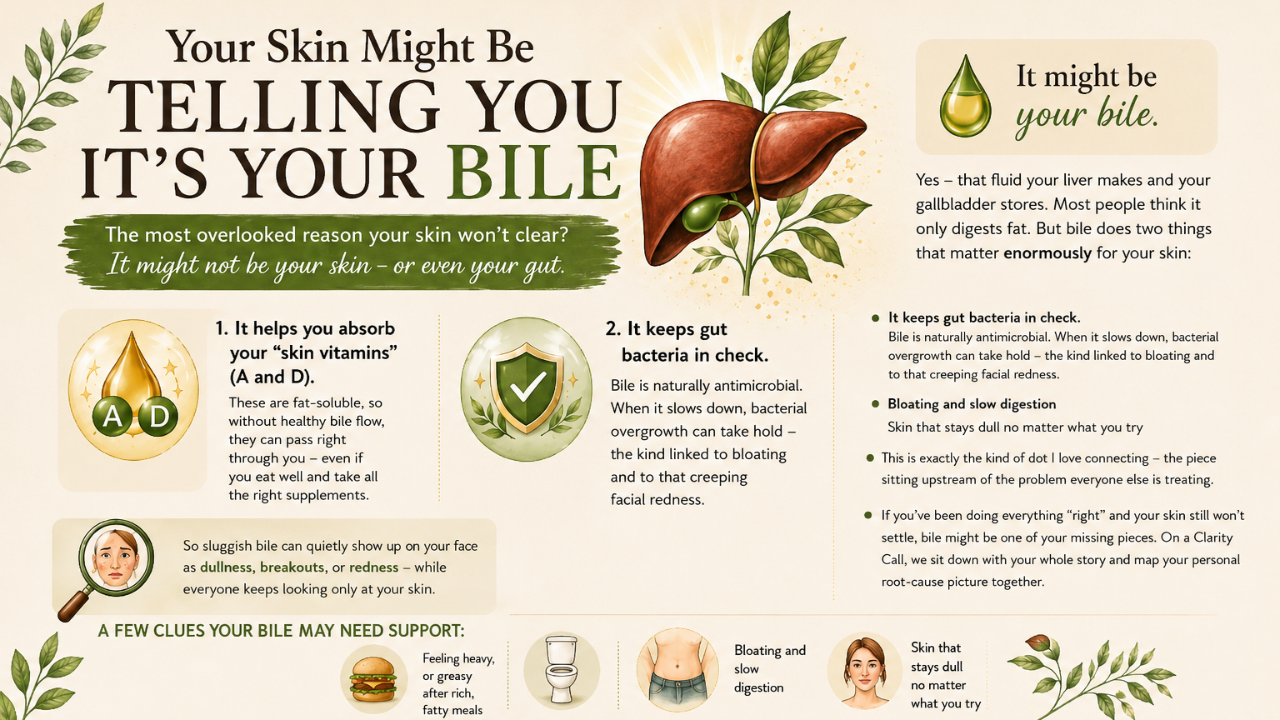
Why your liver and gallbladder may be the most overlooked players in stubborn skin problems — and the science of how bile shapes your gut, your hormones, and your face.
If you’ve struggled with acne, rosacea, eczema, or psoriasis that won’t fully resolve, you’ve probably been told to look at your gut.
And that’s good advice.
The gut-skin axis is real, well-documented science.
But there’s a piece sitting upstream of your gut that almost no one talks about.
It quietly governs how well your gut works, which nutrients reach your skin, and even how much inflammation circulates through your body.
It’s your bile.
Most people think bile is just a fat digester.
It’s far more than that.
Bile is one of the most elegant communication systems in the body — a messenger between your liver, your gut, your microbiome, your immune system, and your metabolism.
And when bile flow falters, the effects ripple all the way out to your skin.
Let’s connect the dots.
What Bile Actually Is (And Does)
Bile is a yellow-green fluid made by your liver, concentrated and stored in your gallbladder, and released into the small intestine when you eat — especially when you eat fat.
It has several jobs that matter directly for skin health:
1. It absorbs fat-soluble vitamins
Vitamins A, D, E, and K — several of which are foundational for skin health and immune regulation — require bile to be absorbed.
No adequate bile = no adequate absorption.
2. It is antimicrobial
Bile acids help control bacterial populations in the small intestine.
Healthy bile flow is part of your defense against bacterial overgrowth.
3. It carries waste out
Bile is a major route by which the liver excretes:
• Processed toxins
• Excess cholesterol
• Used hormones (including estrogen)
4. It signals
Bile acids are not just detergents.
They are signaling molecules that communicate directly with your cells and metabolic systems.
Bile and Your “Skin Vitamins”: The Absorption Problem
Vitamins A and D are two of the most important nutrients for clear, calm, resilient skin.
Vitamin A regulates skin cell turnover.
Vitamin D regulates immune balance and is strongly linked to eczema and psoriasis severity.
Both are fat-soluble.
And fat-soluble vitamins depend on bile for absorption.
So here’s the clinical reality:
You can eat a perfect diet, take high-quality supplements, and still be deficient if bile flow is impaired.
The nutrients are there.
But the delivery system is not working.
Bile, SIBO, and the Redness Connection
Because bile is antimicrobial, it helps regulate bacterial balance in the small intestine.
When bile flow slows — due to gallbladder issues, liver strain, low stomach acid, or sluggish motility — that antimicrobial defense weakens.
This can contribute to Small Intestinal Bacterial Overgrowth (SIBO).
And SIBO is strongly linked to rosacea in clinical research.
It also contributes to:
• Histamine overload
• Facial flushing
• Persistent redness
• Skin heat and sensitivity
An inflamed gut produces and poorly clears histamine.
Histamine dilates blood vessels in the face.
So the redness is not just skin-deep — it is biochemical.
The Gut–Liver Axis and Systemic Inflammation
Your gut and liver are in constant two-way communication through the gut-liver axis.
Bile is a key messenger in this system.
When the gut barrier becomes permeable (leaky gut), bacterial fragments such as LPS enter circulation and reach the liver.
This drives liver inflammation and increases systemic inflammatory load.
That same inflammation is seen in:
• Psoriasis
• Acne
• Eczema
• Rosacea
Healthy bile flow supports both sides of this axis by:
• Maintaining gut microbial balance
• Supporting intestinal barrier integrity
• Clearing inflammatory byproducts via the liver
• Supporting detoxification pathways
When bile flow is sluggish, both systems become compromised.
Inflammation rises.
Skin often reflects this.
Bile Acids as Signaling Molecules: FXR and TGR5
This is where the science becomes even more interesting.
Bile acids activate two key receptors:
FXR (Farnesoid X Receptor)
Located in the liver and intestines.
FXR regulates:
• Bile acid production
• Cholesterol and fat metabolism
• Inflammation
• Gut barrier integrity
FXR activation is generally anti-inflammatory and protective.
TGR5 (GPBAR1)
Found in immune cells, gut, fat, and muscle tissue.
TGR5 regulates:
• Immune balance
• Metabolic function
• Blood sugar regulation
• GLP-1 signaling
Healthy bile signaling promotes metabolic and immune stability.
Disrupted bile signaling promotes inflammation and metabolic dysfunction.
Both of which directly influence skin health.
The Microbiome Completes the Loop
Bile and gut bacteria continuously shape each other.
Bile influences which bacteria survive.
But bacteria also transform bile.
They convert primary bile acids into secondary bile acids.
These secondary bile acids are the strongest activators of FXR and TGR5.
So your microbiome literally determines how your bile signals.
This creates a feedback loop:
Healthy microbiome → healthy bile signaling → lower inflammation → healthier microbiome
Dysbiosis → altered bile signaling → higher inflammation → worsening dysbiosis
Bile sits at the center of:
• Gut health
• Liver function
• Immune balance
• Metabolism
• Skin health
Signs Your Bile Flow May Need Support
These are not diagnostic — but they are clinically relevant patterns:
• Nausea after fatty meals
• Heaviness after rich foods
• Pale or floating stools
• Bloating or sluggish digestion
• Persistent skin congestion
• Reactive or inflamed skin despite good skincare
• History of gallbladder issues or removal
• Fatty liver (MASLD)
Why This Matters for Root-Cause Healing
Bile sits upstream of many systems that conventional skincare treats downstream.
You can:
• Use the right skincare
• Take the right supplements
• Eat a clean diet
And still struggle if bile flow is impaired.
Because the real issue is not at the surface.
It is in the delivery and signaling systems underneath.
Root-cause medicine means following the thread back to where it begins.
For many people with stubborn skin issues, that thread leads back to the liver and bile function.
Could Bile Be Part of Your Skin Story?
If you’ve been doing everything “right” and your skin still isn’t improving, this may be a missing piece of your puzzle.
On a Clarity Call, we look at your full health story:
• Skin history
• Gut health
• Digestion patterns
• Hormones
• Metabolic health
• Symptom timeline
Together, we map what your body may be trying to communicate.
👉 Book Your Clarity Call
When you understand the upstream drivers, healing becomes clearer — and far more effective.
Dr. Ilona Horti Berkoben
The Gut Alchemist™
Functional Medicine for Gut & Metabolic Health