
What your doctor didn't tell you about the bacterium living in nearly half the world's stomachs — and why it could be behind your thyroid issues, brain fog, and sleepless nights.
GUT HEALTH • FUNCTIONAL MEDICINE • AUTOIMMUNITY
Let me paint you a picture.
You've been struggling with fatigue, bloating, stubborn weight, and maybe even thyroid issues.
You've done the rounds — your labs come back "normal," your doctor is not concerned, and you leave with no real answers.
What if a tiny spiral-shaped bacterium, quietly living in the lining of your stomach, was pulling strings across your entire body?
Meet Helicobacter pylori — or H. pylori.
And let's talk about why it deserves far more attention than a standard prescription and a goodbye.
4.4B PEOPLE INFECTED GLOBALLY
40% OF THE WORLD'S POPULATION
36% REDUCTION IN GASTRIC CANCER WITH ERADICATION
What Exactly Is H. Pylori?
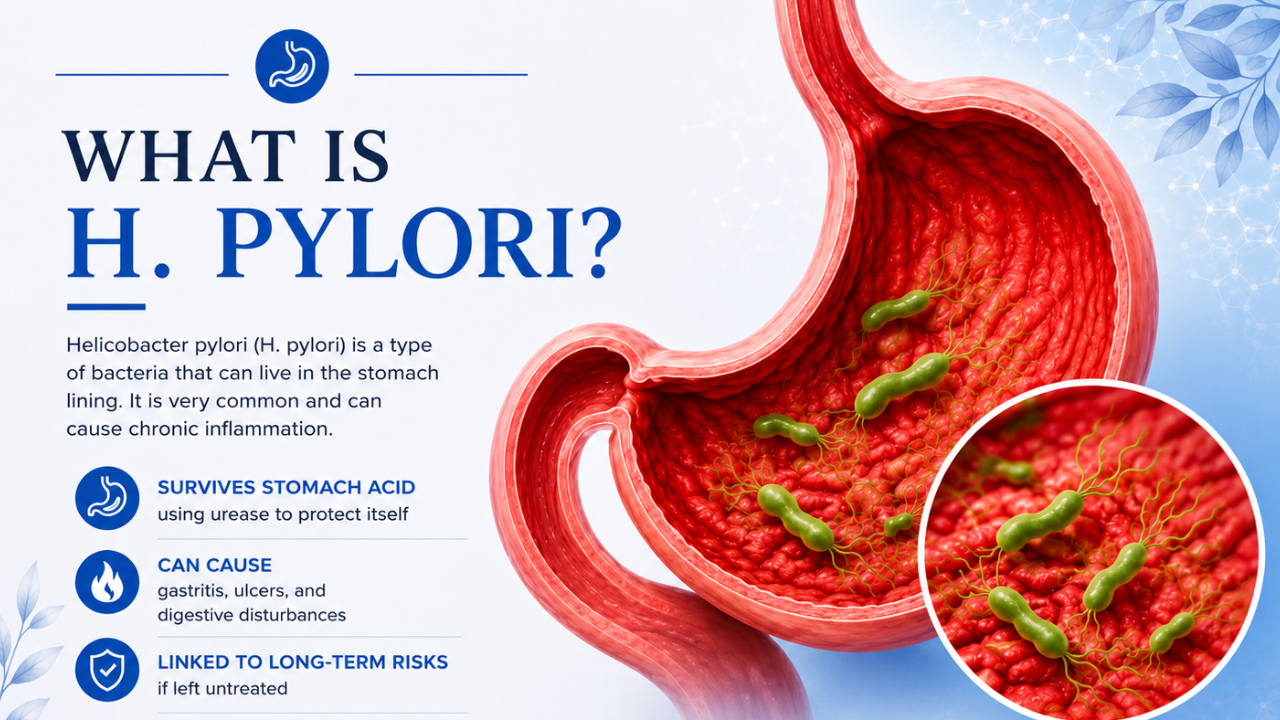
H. pylori is a gram-negative, spiral-shaped bacterium that burrows into the lining of your stomach.
Most people acquire it in childhood, often through contaminated food, water, or close contact with an infected person — and then it quietly takes up residence for decades.
Here's what's striking:
Most people with H. pylori have no obvious symptoms at all.
No ulcer.
No dramatic stomach pain.
Just a slow, silent disruption happening beneath the surface.
Conventional medicine focuses on its role in gastritis, peptic ulcers, and gastric cancer — all very real and serious.
But as a practitioner who connects the dots, what concerns me most is everything that happens beyond the stomach.
"H. pylori is a classified Group 1 carcinogen — the leading cause of infection-attributable cancer worldwide. Yet millions walk around undiagnosed for years."
The Symptoms Nobody Connects to H. Pylori
Yes, H. pylori can cause classic gut symptoms.
But the list of what it can silently contribute to is much longer — and this is where most practitioners stop connecting the dots.
-
Bloating & burping
-
Fatigue & low energy
-
Nausea after eating
-
Brain fog
-
Upper abdominal discomfort
-
Anxiety & mood changes
-
Iron deficiency anaemia
-
Poor sleep quality
-
Low stomach acid
-
Stubborn weight gain
-
Food sensitivities (new ones)
-
Thyroid problems
A 2025 study found that H. pylori infection is associated with a triad of gastrointestinal discomfort, sleep disturbance, and affective (mood) disorders — confirming what functional medicine practitioners have observed clinically for years.
This is not a stomach-only infection.
The Gut–Thyroid Connection Nobody Talks About
This is where it gets fascinating — and this is exactly the kind of dot-connecting that changes people's lives.
If you have Hashimoto's, hypothyroidism, or any autoimmune thyroid condition, and you've never been tested for H. pylori, you need to ask why.
🔬 Molecular Mimicry
H. pylori proteins structurally resemble your own thyroid tissue.
Your immune system, trying to attack the bacterium, can accidentally begin attacking your thyroid too.
This is called molecular mimicry — and it's a key driver of Hashimoto's thyroiditis.
🧬 Autoimmune Activation
Research shows higher rates of H. pylori infection in patients with autoimmune thyroid disease.
Eradicating H. pylori has been shown to reduce thyroid antibodies — meaning the infection may be actively fuelling the autoimmune attack.
💊 Thyroid Medication Absorption
A newly published study found that eradicating H. pylori actually decreases the thyroid hormone replacement dose needed — because the infection was impairing absorption of the medication all along.
🔥 Systemic Inflammation
Chronic H. pylori doesn't just inflame your stomach — it creates a state of low-grade systemic inflammation that can dysregulate immune tolerance throughout the entire body, potentially triggering multiple autoimmune pathways simultaneously.
Why Standard Treatment Often Falls Short
The conventional approach is triple therapy:
Two antibiotics plus a proton pump inhibitor.
And increasingly, this is failing.
Antibiotic resistance is becoming a significant global challenge in managing H. pylori, and first-line treatment may not eradicate the infection completely.
But here's what concerns me even more than the resistance issue:
Even a successful eradication doesn't address the aftermath.
After years of H. pylori infection, your gut is left in a compromised state:
-
Depleted stomach acid
-
Damaged mucosal lining
-
Disrupted microbiome
-
Leaky gut
-
Nutrient deficiencies (particularly B12, iron, zinc, and vitamin D)
-
An immune system that may still be misfiring
Killing the bug is step one.
Rebuilding what it destroyed is the work most practitioners skip entirely.
"Eradication is not the finish line. For my patients, it's the starting gun."
The Functional Medicine Approach — Connecting Every Dot
When a patient comes to me with suspected or confirmed H. pylori, I don't just look at their stomach.
I look at the whole picture.
Testing That Matters
-
Comprehensive stool analysis to assess the microbiome
-
Intestinal permeability testing
-
Immune markers
-
Co-infection screening
-
Thyroid antibodies (TPO, TgAb)
-
Nutrient status — B12, iron studies, ferritin, zinc, vitamin D
-
Cortisol patterns and adrenal function
Because H. pylori doesn't exist in isolation.
Rebuilding the Terrain
-
Stomach acid support
-
Mucosal healing protocols
-
Microbiome restoration
-
Targeted nutrition
Not just eradication.
Addressing the Immune System
If autoimmunity has been triggered, we work on:
-
Calming immune overactivation
-
Reducing inflammatory load
-
Supporting immune tolerance
Because antibiotics alone will never touch this part.
So — Should You Get Tested?
If you have any of the following, I would absolutely recommend getting tested for H. pylori as part of a comprehensive gut assessment:
✦ Diagnosed or suspected Hashimoto's or thyroid disease
✦ Persistent bloating or digestive discomfort
✦ Iron deficiency anaemia that doesn't respond to supplementation
✦ New food sensitivities that appeared seemingly out of nowhere
✦ Fatigue, brain fog, and poor sleep with no clear cause
✦ Difficulty losing weight despite doing everything "right"
You deserve more than a quick test and a prescription.
You deserve a practitioner who asks the right questions, runs the right tests, and actually looks at you — not just your symptoms in isolation.
My approach as The Gut Alchemist is to take a thorough medical history, run targeted functional testing, and build a personalised protocol that addresses the root cause — not just the symptom.
H. pylori is often one piece of a much larger puzzle.
And I love solving puzzles.
WORK WITH DR. ILONA
Ready to Look Beyond the Surface?
If this article resonated with you, your gut is trying to tell you something.
Let's listen to it together — with the right questions and the right tests.
BOOK A DISCOVERY CALL
Dr. Ilona • The Gut Alchemist
Combining Conventional & Functional Medicine • Gut Health • Metabolic Health
This article is for educational purposes and does not constitute medical advice. Please consult a qualified healthcare practitioner for personalised guidance.